
Lithium golf cart batteries have changed what owners expect from an electric cart: more range, less weight, faster charging and almost no routine maintenance. If you are shopping for a new cart, replacing a tired lead-acid pack, or simply trying to understand why lithium models cost more up front, this guide walks you through everything that matters.
We sell and service new and used electric, lithium and gas carts here in Northeast Ohio, so we see both battery types every week. Below you will find a plain-English comparison, realistic expectations for lifespan and cost, charging and winter-care advice for our climate, and what to know before converting an older cart.
What Are Lithium Golf Cart Batteries?
Most lithium golf cart batteries use a chemistry called lithium iron phosphate, usually written as LiFePO4. It is the same family of chemistry used in many home energy storage systems and RVs, chosen because it is thermally stable, tolerates many charge cycles, and delivers steady voltage from full to nearly empty. It is not the same chemistry found in most phones or laptops.
Instead of six or eight separate lead-acid batteries wired in series, lithium golf cart batteries usually come as one sealed pack (sometimes two) with a built-in battery management system, or BMS. The BMS is the brain of the pack. It balances the individual cells, protects against overcharging and over-discharging, and shuts the pack down if temperatures or currents move outside safe limits.
Common voltages
Most modern carts run on a 48-volt system, and that is also the most common voltage for lithium golf cart batteries. Some newer models use higher-voltage packs, such as 51V or 72V nominal systems, to improve hill climbing and acceleration. When you replace or upgrade, the pack voltage has to match what your motor controller and charger are designed for.
Why the BMS matters
A quality BMS is the single biggest difference between good and bad lithium golf cart batteries. It protects your investment, and on many packs it also feeds a state-of-charge display on the dash or connects to a phone app over Bluetooth so you can see exactly how much range is left. When you compare packs, ask what the BMS protects against, how it handles cold weather, and what the warranty covers.
Lithium vs Lead-Acid Golf Cart Batteries: Side-by-Side
Traditional flooded lead-acid batteries have powered golf carts for decades. They are proven, widely available and inexpensive to buy. The question is whether lithium golf cart batteries are worth the higher price for the way you use your cart. The table below compares the two on the points owners care about most.
| Feature | Flooded Lead-Acid (48V) | Lithium (LiFePO4) |
|---|---|---|
| Typical service life | Roughly 4 to 6 years with good care | Often 8 to 10+ years; many packs rated for thousands of cycles |
| Pack weight | Several hundred pounds for a full set | Usually a fraction of lead-acid weight |
| Routine maintenance | Watering, cleaning terminals, equalizing | Essentially none beyond keeping it charged |
| Charging | Slower; best with full charge cycles | Faster; partial charges are fine |
| Performance as charge drops | Cart slows noticeably as voltage sags | Steady speed until close to empty |
| Up-front cost | Lower | Higher, often two to three times as much |
| Cold-weather charging | Can charge in cold; must not sit discharged | Should not charge below freezing unless the pack has built-in heating |
Neither option is wrong. Lead-acid still makes sense for a light-use cart on a tight budget. But for owners who drive often, cover longer distances, or simply want to stop worrying about watering batteries, lithium golf cart batteries usually win on convenience and long-term value.
How Long Do Lithium Golf Cart Batteries Last?
Lifespan is where lithium shines. A well-built LiFePO4 pack is commonly rated for a few thousand full charge cycles, and because most owners rarely drain the pack to zero, the practical life is often longer than the rating suggests. Many manufacturers now back their packs with long warranties. For example, the new Denago models we carry come with an 8-year battery warranty from the manufacturer.
By comparison, a set of flooded lead-acid batteries typically lasts around four to six years, and sometimes less if the cart sits discharged, runs low on water, or is regularly run down to empty. Lead-acid capacity also fades gradually, so the cart loses range year after year before the batteries finally need replacement.
What shortens battery life
- Heat: Storing or charging in extreme heat ages any battery faster.
- Charging below freezing: Charging lithium cells when they are too cold can damage them, which is why good packs block cold charging.
- The wrong charger: A charger not designed for your pack can undercharge or overcharge it.
- Long storage at empty: Letting any pack sit fully drained for months is one of the fastest ways to ruin it.
- Loose or corroded connections: High resistance at a cable end creates heat and voltage drop.
Follow the maker’s guidance and your lithium golf cart batteries should comfortably outlast two or more sets of lead-acid batteries. That longevity is the core of the cost-over-time argument we cover below.
Charging Lithium Golf Cart Batteries the Right Way
Charging lithium golf cart batteries is simpler than charging lead-acid, but it has a few rules. The most important one: use a charger designed for your specific pack. Lithium packs need a charge profile that matches their chemistry and voltage. A lead-acid charger can confuse the BMS, fail to fully charge the pack, or trigger fault codes.
Everyday charging habits
- Plug in after most rides. Unlike lead-acid, lithium golf cart batteries do not need to be run down before charging, and partial top-ups do not hurt it.
- Charge in a dry, ventilated spot such as a garage, away from standing water.
- Use a properly grounded outlet. Avoid long, thin extension cords, which can cause voltage drop and slow charging.
- Let the charger finish its cycle. The BMS and charger work together to balance the cells near the top of the charge.
- Keep the charging port and plug clean and free of corrosion.
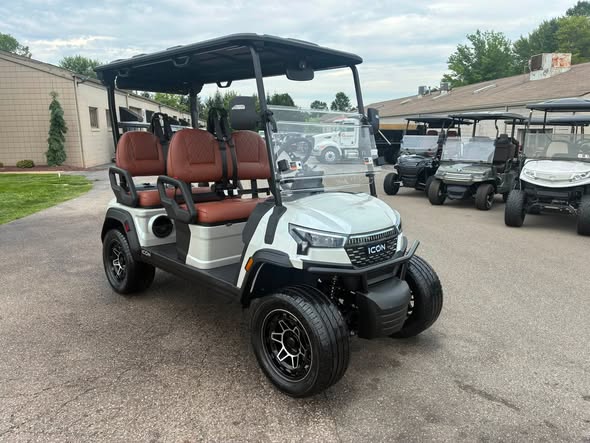
Many new carts, including several of the Denago and ICON lithium models in our lithium golf carts inventory, have an onboard charger. That means you simply plug the cart into a standard outlet with a cord. Older carts and many conversions use an external charger instead.
How long does charging take?
Charge time depends on the size of the pack, how empty it is and the output of the charger. As a general rule, lithium golf cart batteries charge noticeably faster than a comparable lead-acid set, and a partially drained pack can often be topped off in a few hours. Lead-acid batteries, by contrast, slow down near the end of the charge and typically need a longer full cycle to stay healthy.
Weight, Range and Performance
Weight is one of the most noticeable differences. A full set of six 8-volt lead-acid batteries weighs several hundred pounds. Lithium golf cart batteries delivering similar or better usable capacity usually weigh a fraction of that. Dropping that much weight changes how a cart feels.
- Quicker acceleration: Less mass to move means a livelier launch.
- Better hill climbing: Lithium golf cart batteries hold their voltage under load, so the cart does not bog down as the charge drops.
- Less wear: Lighter carts are easier on tires, brakes, suspension and turf.
- More payload room: Weight saved on batteries can be used for passengers and gear.
Range depends on pack capacity, terrain, tire size, speed, passenger load and temperature, so be cautious about any single mileage number. Generally speaking, lithium golf cart batteries deliver more usable range than lead-acid batteries of a similar size, because you can use a greater share of their rated capacity without damaging them. Lifted carts with large all-terrain tires will always use more energy than a stock cart on smooth pavement.
Steady power all the way down
With lead-acid, you feel the cart getting slower as the batteries drain. With lithium, speed and torque stay consistent until the pack is nearly empty. For families cruising a campground or neighborhood, that consistency is one of the most appreciated benefits of lithium golf cart batteries.
Cost Over Time: Are Lithium Golf Cart Batteries Worth It?
There is no getting around it: lithium golf cart batteries cost more on day one. A lithium pack or conversion kit commonly costs about two to three times as much as a set of quality flooded lead-acid batteries. The real question is what you spend over the years you own the cart.
How the math usually works
- Replacements: Over the typical life of one lithium pack, you might buy two sets of lead-acid batteries.
- Maintenance: No distilled water, fewer corroded terminals, no acid damage to battery trays and frames.
- Electricity: Lithium charges more efficiently, so less energy is lost as heat during charging.
- Your time: No watering schedule and fewer surprise dead batteries in spring.
- Resale: Carts with healthy lithium packs tend to attract more buyers when it is time to sell or trade.
If you drive your cart often, the total cost of ownership frequently evens out or tips in favor of lithium golf cart batteries. If your cart sits most of the year and sees only light use, lead-acid can still be the budget-friendly choice. The U.S. Department of Energy has helpful background on battery technology and efficiency at energy.gov if you want to dig deeper into the science.
Financing can also make the up-front cost easier. With approved credit, golf cart financing through our lending partners lets you spread out payments on a new lithium cart. Ask about current offers, since promotions change throughout the year.
Converting a Cart to Lithium Golf Cart Batteries
If you love your current cart but the lead-acid batteries are near the end of their life, converting to lithium golf cart batteries is a popular upgrade. It is very doable on most common models, including the EZGO TXT and RXV, Club Car DS, Precedent and Onward, and Yamaha Drive families. However, a proper conversion is more than swapping boxes.
What a good conversion includes
- A pack sized for your needs: Choose capacity based on how far you drive, your terrain and whether the cart is lifted.
- A matched charger: The charger must be programmed for the lithium pack. Your old lead-acid charger usually will not work.
- Controller compatibility: The pack’s continuous and peak current ratings should suit your motor and controller, especially on upgraded high-speed or high-torque setups.
- Secure mounting: Lithium packs are smaller, so brackets or adapter trays are needed to keep the pack from shifting.
- A state-of-charge gauge: Lead-acid voltage meters do not read lithium accurately, so a lithium-compatible gauge or app is important.
- Model-specific wiring: Some older carts have charging systems or onboard computers designed for lead-acid that must be addressed during the install.
Because the cart gets lighter, some owners also notice a firmer ride. That is normal and usually not a concern. For safety and warranty reasons, we recommend a professional install, especially on carts with modified controllers or motors. If you would rather move into a cart that already has lithium, you can also trade in your current one through our trade-in program.
Winter Care for Lithium Golf Cart Batteries in Ohio
Northeast Ohio winters are hard on batteries of every type, so storage matters. The good news is that lithium golf cart batteries handle long storage far better than lead-acid, because they self-discharge slowly and have no water to top off. The key rule is simple: do not charge a lithium pack when the cells are below freezing unless the manufacturer says the pack has built-in heating or low-temperature protection.
Winter storage checklist
- Before storage, charge the pack to the level the manufacturer recommends. Many suggest a partial charge rather than 100 percent for long storage.
- Use the pack’s storage mode or disconnect switch if it has one, and turn the key off.
- Store the cart in a garage or shed if possible, out of snow and road salt.
- Check the state of charge every month or so and top up if the maker recommends it.
- If the cart was in a cold space, let it warm up before charging in spring.
- Clean off salt and grime so terminals and wiring stay corrosion-free.
If you still have lead-acid
Lead-acid batteries need the opposite approach: store them fully charged and check water levels before storage. A discharged lead-acid battery can freeze and crack in cold weather, while a fully charged one resists freezing much better. Many owners use a maintainer or charge them periodically through the winter. For a full seasonal routine, see our golf cart maintenance guide.
How to Choose Lithium Golf Cart Batteries
Not all lithium golf cart batteries are equal. When you compare new carts or conversion kits, a few questions separate a reliable pack from a gamble.
- Chemistry: Look for LiFePO4, the standard for golf cart use.
- Capacity: Measured in amp-hours (Ah) at a given voltage. More capacity generally means more range.
- Warranty: Longer battery warranties signal confidence. Read what is covered and whether it is prorated.
- BMS features: Low-temperature charge protection, cell balancing, Bluetooth monitoring and clear fault reporting.
- Charger included: Confirm a matched charger comes with the lithium golf cart batteries or the cart.
- Local support: A dealer nearby who can diagnose and service the pack is worth a lot.
Brands like Denago, ICON, Club Car and EZGO all offer lithium-powered models. You can read about current manufacturer offerings directly from Denago, or browse the ICON carts and other brands we stock. If you are still deciding between power sources, our guide to choosing a gas vs electric golf cart covers the bigger picture.
New cart or used cart with lithium?
A new cart gives you a full factory warranty and the latest tech. A used cart with lithium golf cart batteries can be a great value, but ask how old the pack is, whether it has a warranty left, and whether the original charger comes with it. Our used golf cart checklist explains how to evaluate any pre-owned cart before you buy.
Signs Your Lithium Golf Cart Batteries Need Attention
Lithium golf cart batteries are low-maintenance, not no-attention. Catching small issues early protects the pack and keeps you from getting stranded.
- Range drops suddenly rather than gradually.
- The cart stops unexpectedly, which can mean the BMS is protecting the pack.
- The charger will not start or shows a fault light.
- The state-of-charge gauge jumps around or reads inaccurately.
- You notice heat, swelling, odor or damage around the pack. Stop using the cart and call a professional.
Many of these symptoms turn out to be a loose connection, a charger issue or a gauge that needs recalibration rather than a failed pack. Call us before replacing anything expensive.
Frequently Asked Questions
Can I use my old lead-acid charger on lithium golf cart batteries?
In most cases, no. Lithium golf cart batteries need a charger with a matching voltage and charge profile. A lead-acid charger may not fully charge the pack and can trigger BMS faults. Use the charger supplied or recommended by the pack maker.
How long do lithium golf cart batteries last?
A quality LiFePO4 pack commonly lasts 8 to 10 years or more with normal use, and many are rated for thousands of charge cycles. Actual life depends on usage, storage and charging habits.
Is it OK to leave a lithium cart plugged in?
Many lithium golf cart batteries with a matched charger and BMS are designed to stop charging when full, but follow your manufacturer’s instructions. For long winter storage, most makers recommend a specific storage charge level rather than leaving the charger connected indefinitely.
Are lithium golf cart batteries safe?
LiFePO4 is considered one of the most stable lithium chemistries, and a quality BMS adds layers of protection. As with any battery, use the right charger, avoid physical damage and have a professional handle installation and repairs.
Will lithium make my cart faster?
Lithium golf cart batteries usually improve acceleration and hill climbing and keeps speed steady as the charge drops. Top speed is mostly set by the motor, controller and gearing, so the battery alone does not dramatically raise it.
Shop Lithium Carts and Get Expert Advice
For most owners who use their cart regularly, lithium golf cart batteries deliver a better experience: lighter weight, stronger and steadier performance, faster charging, easier winter storage and years of low-maintenance service. Lead-acid still has a place for budget-focused, light-use carts, and we are happy to help you weigh both options honestly.
Ready to see the difference for yourself? Browse our full inventory of new and used carts in the Custom Carts shop, or contact us with questions about conversions, charging or winter storage. You can also call or text (330) 752-8570 to schedule a visit with our Northeast Ohio team.